A blog guide to the Benazir Income Support Programme: introduction, procedure, steps and final words
Introduction
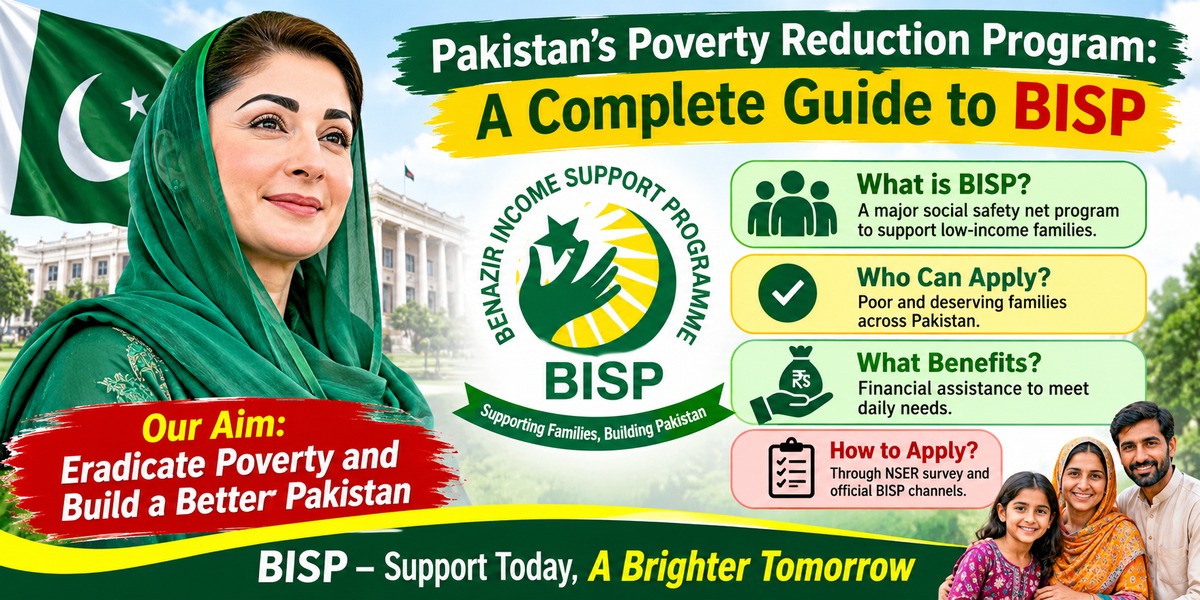
Few challenges in Pakistan are as persistent as poverty. Rising food prices, fuel costs and unstable employment push millions of families to the edge every year. The state’s answer for nearly two decades has been the Benazir Income Support Programme (BISP), which was formed in July 2008 as a social safety net. It now sits under the Poverty Alleviation and Social Security Division.
BISP is built on a simple idea. Money is paid to women, because evidence from around the world shows that cash in a mother’s hands tends to reach children’s food, health and schooling. Over the years the programme has grown from a single cash transfer into a package of related schemes. This guide covers what BISP is, who qualifies, how to register, how payments work, and what to watch out for.
The Main Components of the Programme
1. Benazir Kafalat. This is the core, unconditional quarterly cash transfer. It is paid to eligible women regardless of whether their children attend school, and families can spend it on whatever they need most.
2. Benazir Taleemi Wazaif. This is an education stipend for children of Kafalat families. It is tied specifically to a child’s school attendance. Reports in early 2026 put the quarterly rate at Rs 2,500 for primary school boys and Rs 3,000 for girls. Eligible children are typically aged 4 to 22, and attendance must stay at 70% or above each quarter.
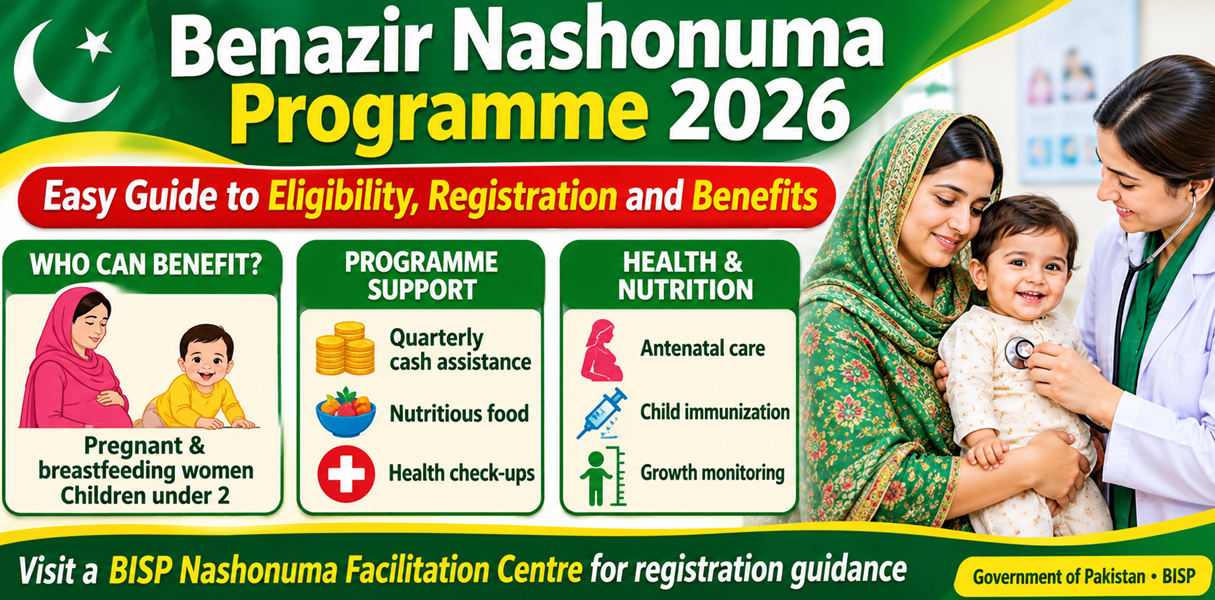
3. Benazir Nashonuma. This supports maternal and child nutrition, mainly for pregnant and breastfeeding women and young children.
Together these cover income, education and nutrition, the three areas where poverty does the most lasting damage.
Who Is Eligible?
Eligibility is not based on recommendations or personal connections. Early on, recipients were selected by parliamentarians through recommendations, but the programme has since moved to a data-driven system. The main elements are:
- The National Socio-Economic Registry (NSER). This database holds household information such as income, assets, housing, family size and education. Each household gets a poverty score from this data.
- A cut-off score. Households below the threshold qualify for support.
- A valid CNIC. The woman applying needs her own Computerised National Identity Card.
- Household circumstances. Pakistani nationality, family size and living conditions all feed into the assessment.
Some commonly cited income thresholds appear online, but they are only rough guides. The poverty score from the survey decides eligibility, so you cannot know the outcome in advance.
Step-by-Step: How to Register
- Check your status by SMS. Send your 13-digit CNIC number to 8171. You will get a reply saying whether your household is eligible, needs a survey, or is not currently eligible.
- Use the official web portal. The BISP website offers a CNIC-based eligibility check if you prefer not to use SMS.
- Visit the nearest BISP Tehsil Office or registration centre. If the check says a survey is needed, go there with your original CNIC and your family’s information. Bring children’s B-Forms from NADRA if you want to register them for education support.
- Complete the survey. Staff record details about your household, and the data goes into NSER, where your poverty score is calculated.
- Wait for the result. You will get a confirmation or rejection message from 8171. Processing can take some time, so keep your mobile number active.
- Complete payment-related steps if you are eligible. These now include digital wallet setup, covered in the next section.
The Move to Digital Payments
A major recent change is that payments are shifting to digital wallets. The programme announced that an upcoming Kafalat instalment would be paid exclusively through digital wallets, making SIM registration mandatory. Women without a SIM were advised to visit their nearest BISP office with their own mobile phone to collect a free SIM, and the reported deadline was 15 June 2026.
For beneficiaries, this means:
- Register your Benazir SIM and activate the wallet.
- Keep your CNIC and phone number consistent in the records.
- If you have fingerprint or biometric problems, ask the BISP office about the facial verification alternative.
Digital payment is meant to cut leakage, reduce long queues and make the system more transparent. It does mean that women with little phone access or digital literacy need extra help, ideally from a family member or a trusted local office.
How Much Do Beneficiaries Receive?
The Kafalat amount changed several times in 2026, and reports conflict, so no single definitive figure is given here. Reports show the quarterly amount raised from Rs 13,500 to Rs 14,500 starting from Ramazan, and later reports of a further increase to Rs 18,000. Another outlet reported an increase from Rs 13,500 to Rs 19,500. Before you rely on any number, confirm the current rate on the official BISP website (bisp.gov.pk) or at your nearest BISP office.
Payment Collection and Verification
Payments come in quarterly instalments, and recent tranches have been released in phases across districts. For example, over 183,000 women in Sargodha district received payments in the March to May 2026 tranche. This means your payment date may differ from a neighbour’s in another district.
Practical tips:
- Collect payment only through authorised channels such as your registered wallet or an official BISP payment point.
- Do not hand your CNIC, PIN or SIM to anyone else.
- Ask for help at an official BISP office if your biometric verification fails.
Common Problems and How to Solve Them
“My household shows as ineligible.” The score may be outdated. If your circumstances have changed, you can ask for a fresh survey at a BISP office.
“I’m eligible but haven’t received payment.” Check that your wallet is activated, your CNIC details match the records, and your district’s tranche has been released.
“My child’s education stipend was stopped.” Attendance may have dropped. According to one guide, falling below 70% for three consecutive quarters leads to suspension. Keep school attendance records and update B-Forms.
“Someone asked me for money to speed up my application.” This is a scam. See below.
Beware of Fraud
Every time payments are released, scammers target vulnerable families. The rule is simple: BISP never charges a fee for registration, status checks or payments. Be careful with:
- Callers or WhatsApp messages claiming you have “won” or been “selected” and asking for fees
- Agents who promise to raise your poverty score for a payment
- Fake websites and links that ask for your CNIC and PIN
- Anyone asking for your OTP
Use only the 8171 service and the official BISP website, and report suspicious activity to BISP’s helpline or office.
Why BISP Matters
BISP is more than a cash handout. Predictable quarterly income lets families buy food, repay small debts, cover medical costs and keep children in school instead of sending them to work. Its education and nutrition components add a longer-term goal of breaking the cycle in which poor health and poor schooling pass poverty from one generation to the next. Reports in mid-2026 described the education support as reaching 12.4 million children.
The programme still has real limits. Cash transfers ease hardship but do not create jobs. Data can lag behind changing circumstances, and digital systems can exclude those with weak connectivity or no phone. Lasting poverty reduction needs complementary measures such as skills training, microfinance access, healthcare and job creation, along with continuous improvement of targeting.
Final Words
BISP remains one of Pakistan’s most significant tools against poverty. If you think your family may qualify, start by sending your CNIC to 8171 and following the official process. If you already benefit, keep your SIM, wallet, CNIC and children’s B-Forms up to date, and keep children attending school. If you know someone who might qualify, help them register, especially women who find the process hard to navigate alone.
Above all, trust only official channels, never pay anyone for a service that is free, and treat the scheme as a stepping stone toward greater independence rather than a permanent solution. Used well, support like this helps families stand a little steadier and gives their children a better chance than they had.