If you’ve been to a wheat mandi or a fertilizer shop in Punjab lately, chances are someone’s mentioned the Kisan Card to you. Maybe your neighbor got one. Maybe your local agriculture office has a poster about it. Maybe you’ve already sent an SMS to 8070 and you’re just waiting to see what happens next. Whatever brought you here, let’s actually break down what this card is, whether you qualify, and exactly how to get one without the confusing SEO fluff most pages bury this under.
Quick honest note before we start: there’s a lot of noise online about this scheme, including some sites offering online portals and step by step web forms that don’t match how the programme is actually being run right now. As far as the official Punjab government page describes it, this is primarily an SMS based registration system tied to your CNIC, followed by an in person biometric step at a Bank of Punjab branch. So that’s what we’ll walk through here and if the process has shifted by the time you’re reading this, the official Punjab government portal and the 8070/8171 helplines are always your safest bet to confirm.
What Exactly Is the Kisan Card ?
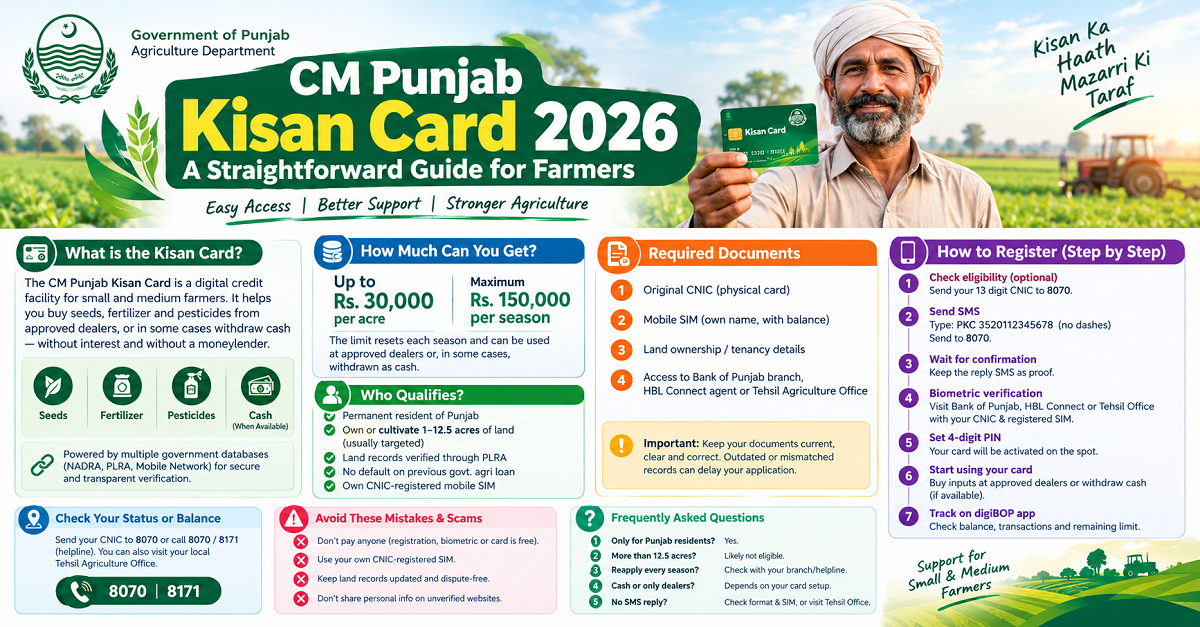
The CM Punjab Kisan Card (also written as Kissan Card) is a joint initiative between the Punjab Agriculture Department and the Punjab Information Technology Board, run in partnership with the Bank of Punjab. It’s essentially a digital credit facility for small and medium farmers think of it as a working capital card that lets you buy seeds, fertilizer, and pesticides from approved dealers, or in some cases withdraw cash, without paying interest and without going through a moneylender.
What makes it interesting is how it’s built. The system pulls together several government databases into one framework NADRA for your identity, the Punjab Land Records Authority (PLRA) to verify you actually own or work the land you’re claiming, and the Pakistan Mobile Database to confirm your registered SIM. That’s why the mobile number you use for registration has to be your own, registered on your own CNIC the whole verification chain depends on it.
Each card is valid for six months at a time, tied to a cropping season, and the scheme is reportedly costing the Punjab government somewhere around Rs. 9.5 billion per season to run so this isn’t a small pilot, it’s a serious province-wide push to get small farmers off informal lending.
How Much Can You Actually Get ?
Here’s the number that matters most: eligible farmers can access up to Rs. 30,000 per acre, capped at a maximum of Rs.150,000 per season overall. So if you’re farming on the smaller end say 2 or 3 acres your limit will scale down accordingly; the Rs.150,000 ceiling really only kicks in once you’re near the top of the eligible landholding range.
That limit resets each season, and the funds are meant to be spent through the card at government-notified dealers via POS machines for inputs like seeds and fertilizer, or in some cases withdrawn as cash through your linked account.
Who Qualifies?
The eligibility bar here isn’t complicated, but it’s specific:
1. You need to be a permanent resident of Punjab.
2. You need to own or actively cultivate agricultural land the scheme targets landholders with roughly 1 to 12.5 acres. If you’re well above that range, you’re likely outside the scheme’s target group; if you’re a landless tenant farmer, check with your local agriculture office, as eligibility can hinge on formal land records.
3. Your land records need to check out through PLRA this happens automatically once you register, so if your land record is outdated, unregistered, or under dispute, that’s going to slow things down or block you entirely.
4. You must not have defaulted on any previous government agricultural loan.
5. Your mobile SIM has to be registered under your own CNIC not your brother’s, not your father’s. The system checks this, and a mismatch is one of the most common reasons applications stall.
What You’ll Need Before You Register ?
Nothing exotic, but have it sorted before you start:
1. Your original CNIC (you’ll need the physical card later for biometric verification).
2. A mobile SIM registered in your own name, with enough balance to send an SMS.
3. Basic land ownership or tenancy details matching what’s on record with PLRA.
4 Access to a Bank of Punjab branch, HBL Connect agent, or your local Tehsil Agriculture Office for the in person step.
How to Register Step by Step?
Step 1: Check your eligibility first (optional but smart)
Before committing to the full registration, you can send your 13 digit CNIC number no dashes, no spaces to 8070 to get a quick read on whether you show up as eligible in the system.
Step 2: Send the registration SMS
Open your messaging app on your own CNIC-registered SIM.
Type exactly:
PKC space 13 digit CNIC number (no dashes).
For example: PKC 3520112345678
Send this to 8070. This is currently the primary, official registration method no app download, no office visit, no internet connection required at this stage.
Step 3: Wait for the confirmation reply
You should get a reply SMS confirming your registration status. Keep this message it’s your proof that you actually applied, and you may need to reference it later if there’s a dispute or delay.
Step 4: Complete biometric verification in person
This is the part a lot of people skip and then wonder why their card never arrives. Once your SMS registration goes through, you’re expected to visit your nearest Bank of Punjab branch, an HBL Connect agent, or your local Tehsil Agriculture Office with your original CNIC and the same mobile phone/SIM you registered with. A banking or agriculture officer will run a biometric thumbprint verification to confirm you’re really you.
Step 5: Get your card activated
Once biometric verification clears, your Kisan Card is typically activated on the spot. You’ll usually be asked to set a 4-digit ATM PIN right there don’t share this with anyone, including helpful dealers or agents.
Step 6: Start using it
From here, your card works at government-notified Point of Sale machines at approved agricultural dealers, letting you buy seeds, fertilizer, and pesticides directly against your allocated credit limit. Some farmers also use it for cash withdrawal, depending on how their account is set up.
Step 7: Track everything through the digiBOP app
The Bank of Punjab’s digiBOP mobile app lets you monitor your card balance, transaction history, and remaining seasonal limit in real time, so you’re not stuck guessing how much you’ve already used.
Checking Your Status or Balance:
If you’re not sure where your application stands, or you want to check your remaining limit, send your CNIC number to 8070 again, or call the Kisan Card helpline. Different sources list both 8070 and 8171 as active helpline numbers for Punjab farmer support if one doesn’t get you anywhere, try the other, or head straight to your local Tehsil Agriculture Office.
A Few Honest Warnings:
Nobody official will ask you for money. The SMS registration is free, the biometric verification is free, and the card itself is free. If someone an agent, a dealer, a random caller asks for payment to speed up your registration or guarantee approval, that’s a scam. Hang up.
Your SIM matters more than you’d think. A huge share of registration failures trace back to using a SIM that isn’t registered on your own CNIC. If your family shares SIMs (which is extremely common), sort this out before you even send the first SMS, it’ll save you a frustrating runaround later.
Land records need to be current. If your land hasn’t been formally transferred, is still in a deceased relative’s name, or has any kind of dispute attached, the PLRA verification step is going to catch that. It’s worth sorting out your land records at the local revenue office before you register, rather than after you’ve been rejected.
Watch out for lookalike websites. Because this scheme has been written about by dozens of unofficial blogs (some genuinely helpful, some just chasing search traffic), you’ll come across sites offering online application portals with forms asking for your CNIC and bank details. Stick to the official Punjab government channels and the 8070/8171 shortcodes don’t hand over personal information on a site you can’t verify.
Frequently Asked Questions:
1. Is the Kisan Card only for Punjab residents?
Yes, this specific scheme is administered by the Punjab government and is limited to permanent residents of Punjab with land in the province.
2. What if I own more than 12.5 acres?
The scheme is designed around small and medium farmers, generally in the 1–12.5 acre range. If your holding is significantly larger, you likely fall outside the target group for this particular card.
3. Do I need to reapply every season?
Since the card is valid for roughly six months at a time, tied to a cropping season, check with your Bank of Punjab branch or the helpline about renewal requirements as your card approaches expiry.
4. Can I withdraw cash, or is it only for buying inputs at approved dealers?
It depends on how your account is configured some farmers report being able to withdraw cash, while the core design of the scheme is built around cashless purchases at POS machines with approved agricultural dealers. Confirm your specific card’s functionality with your issuing branch.
5. What happens if my SMS registration doesn’t get a reply?
Double check that you sent it from your own CNIC registered SIM, with the exact format (PKC, space, 13 digit CNIC, no dashes). If it still doesn’t work, visit your nearest Tehsil Agriculture Office or Bank of Punjab branch directly rather than repeatedly re-sending the SMS.
Final Thoughts:
The Kisan Card is one of the more genuinely useful pieces of digital infrastructure Punjab’s agriculture department has rolled out it cuts out the middleman and the informal lender, and it puts real seasonal credit directly in farmers’ hands. But like most government schemes, the value is entirely in getting the process right the first time: correct SIM, current land records, and showing up for that biometric step in person. Get those three things sorted, and the rest tends to move quickly.
This post reflects publicly available information as of 2026 and is meant as a general guide, not official government content. For the latest eligibility rules, loan limits, and registration steps, always confirm directly with the official Punjab government Kisan Card page, your local Tehsil Agriculture Office, or the 8070/8171 helplines