If you’ve spent any time on a Pakistani university campus in the last few months, you’ve probably heard someone talk about the laptop scheme, usually in that half hopeful, half confused tone students get when a government programme sounds too good to be true. I get asked about this constantly, so I figured it was time to actually sit down and lay out what’s real, what’s rumor, and what you need to do if you want a shot at one of these laptops.
Quick heads up before we dive in this scheme runs in phases, and phases open and close without much warning. As of this writing, the most recent round (Phase V) closed its registration on August 1, 2026. That doesn’t mean the scheme is dead it’s been relaunched again and again since 2013, and another phase will almost certainly open. So think of this post as your prep guide: get everything ready now, so the moment applications reopen, you’re not scrambling.
Let’s get into it. So,
What Is the PM Laptop Scheme, Really?
The Prime Minister’s Laptop Scheme (you’ll also see it written as PMYLS or PMNLS) is a government initiative that hands out free laptops to high achieving students at public sector universities. It’s run under the Higher Education Commission (HEC) in partnership with the Prime Minister’s Youth Programme, and the idea is pretty simple: a lot of talented students can’t afford a decent laptop, and in 2026, trying to get through a degree without one is genuinely rough. Online classes, research, freelancing, job applications it all runs through a screen now.
This isn’t a brand new scheme, by the way. It goes all the way back to 2013, and it’s been through several phases and even a temporary shutdown when the government changed. Each round has distributed anywhere from 100,000 to half a million laptops, so this isn’t some small pilot project it’s one of the bigger student-support programmes in the country.
Who Actually Qualifies?
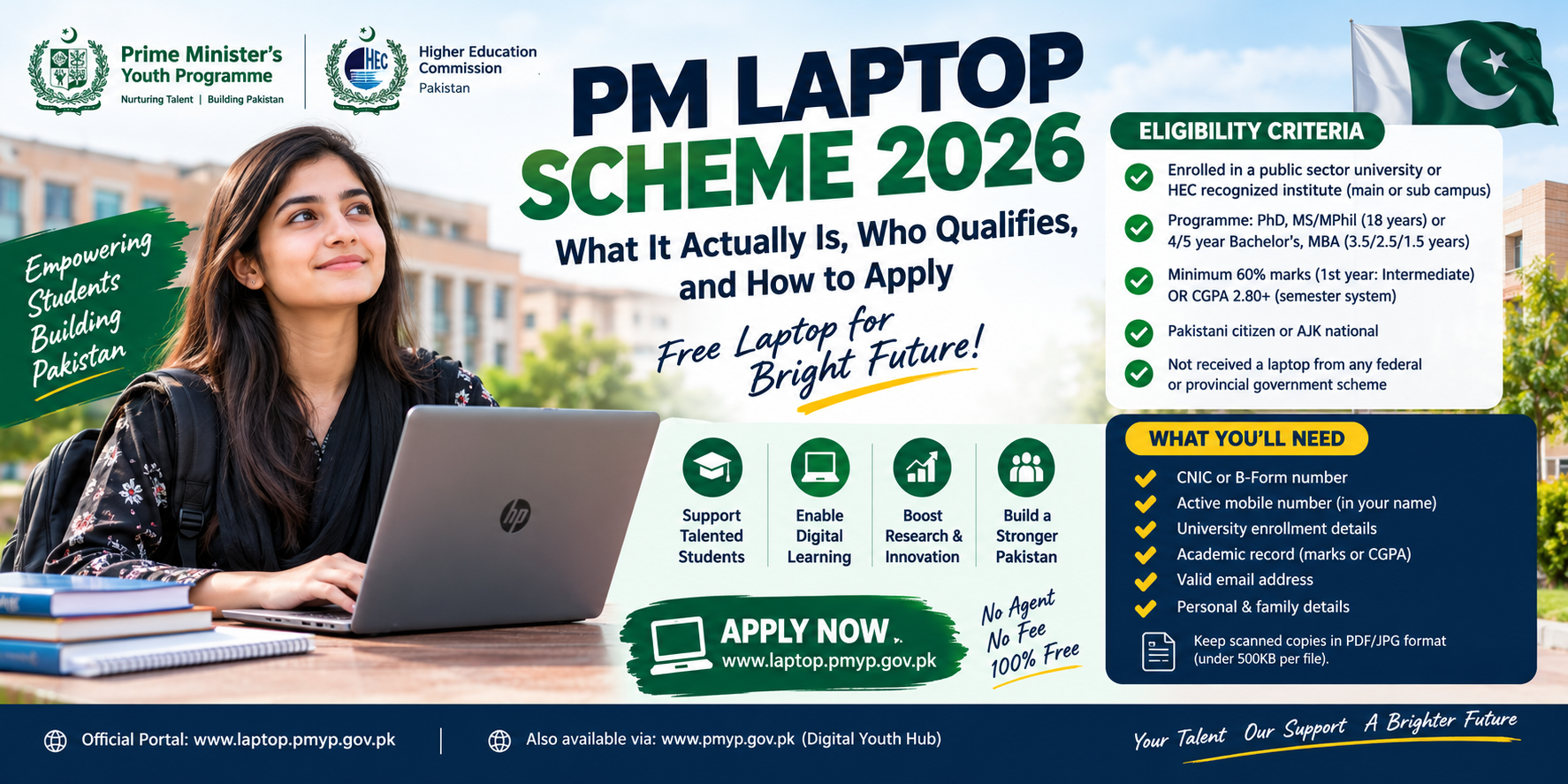
This is where most students trip up, so pay attention here. The eligibility rules (pulled straight from the official criteria published on the HEC/PMYP laptop portal) look like this:
=> You need to be enrolled in a public sector university or an HEC recognized Degree Awarding Institute either the main campus or an officially recognized sub campus. Affiliated colleges of public universities generally don’t count, so double check your institution’s exact status before you get your hopes up.
=> Your programme has to be one of the eligible ones: PhD, MS/MPhil (the 18 year equivalent), or a 4 year or 5 year Bachelor’s degree. MBA programmes (3.5 year, 2.5 year, or 1.5 year) are also included.
=> Your grades need to clear the bar. First year students need at least 60% marks in intermediate. If you’re beyond first year, you need a CGPA of 2.80 or higher in the semester system, or 60% marks if your university runs the annual exam system.
=> You need to be a Pakistani citizen or an AJK national.
=> You can’t have already received a laptop from any federal or provincial government scheme. This one trips a lot of people up the rule is strict and mutual. If you’ve taken a laptop from a provincial scheme (like the Punjab CM Laptop Programme), you’re automatically disqualified from the federal one, and vice versa. You don’t get to try both.
If you’re on the fence about whether your programme or your CGPA counts, it’s worth checking directly with your university’s scholarship or laptop scheme focal person rather than guessing the rules get applied strictly at the verification stage, and there’s no room for “close enough.”
What You’ll Need Before You Start?
Nothing exotic here, but have these ready so the application doesn’t stall halfway through:
=> Your CNIC or B-Form number (B-Form if you don’t have a CNIC yet).
=> An active mobile number registered in your own name you’ll need it for OTP verification, and this is non-negotiable.
=> Your university enrollment details (registration/roll number, department, programme, current semester).
=> Your academic record intermediate marks if you’re a first year student, or your CGPA/percentage if you’re beyond that;
1. A valid email address you actually check.
2. Basic personal and family details as they appear on your CNIC/B-Form.
Keep scanned copies handy in PDF or JPG format, and don’t go overboard on file size most portals reject anything bulky, so aim for under 500KB per file if you can.
How to Actually Apply Step by Step:
Here’s the part everyone actually wants. The whole process happens through the official Prime Minister’s Youth Programme portal, and it’s meant to be done without any agent, cyber café “help,” or WhatsApp middleman. Genuinely, nobody should be charging you a rupee for this.
Step 1: Go to the right portal.
=> Head to the official laptop scheme page under the PM Youth Programme (www.laptop.pmyp.gov.pk or find it through the Digital Youth Hub on www.pmyp.gov.pk ). Don’t trust random blogs or Facebook pages claiming to be the “official portal” there’s only one, and it’s a government run www.gov.pk domain.
Step 2: Hit Apply Now and enter your CNIC/B-Form number.
=> You’ll be asked to fill in your CNIC or B-Form number, solve a quick captcha, and submit. This is what pulls you into the system.
Step 3: Read the instructions and accept them.
=> There’s usually an on-screen instructions page before you continue. Don’t just click through blindly it tells you what counts as disqualifying information, and it’s worth thirty seconds of your time.
Step 4: Fill out the form it comes in three parts.
The registration form is broken into three sections. Your CNIC/B-Form number will already be filled in from step 2. You’ll then add:
1. Your personal details (name exactly as it appears on your B-Form/CNIC or matric certificate). 2. Don’t get creative with spelling here.
3. Your academic details (university, programme, semester, CGPA or marks).
4. Your contact information (mobile number, email, address).
=> Go slow on this part. A mismatched name or a wrong CGPA is one of the most common reasons applications get sent back.
Step 5: Submit and know what happens next
Once you hit submit, your application doesn’t just vanish into a black hole. It goes to the PMYP system and, at the same time, to your university’s designated focal person. That focal person is the one who actually checks whether you’re really enrolled, whether your academic details match university records, and whether everything you entered is accurate. Sometimes they’ll reach out asking for supporting documents, so keep an eye on your phone and email.
Step 6: Watch your status
If everything checks out, your application status moves to “Verified”. If something’s off wrong data, you don’t meet the criteria, or you’ve already received a laptop under another scheme, it gets marked “Disapproved”. If you genuinely think there’s been a mistake, you can reach out to HEC or PMYP support through the official portal to sort it out.
Step 7: Wait for the merit list.
Once verification wraps up for everyone, the merit list gets published, and distribution details follow. This part is entirely out of your hands no calling anyone speeds it up.
If you ever get stuck figuring out who your university’s focal person even is, most portals have a “Search Focal Person” section where you just select your city and university and it tells you who to contact.
A Few Things Worth Knowing Before You Apply
1. It’s completely free. I really want to underline this one. No agent, no “processing fee,” no third party website, no WhatsApp number that promises to “fast track” your application. The government doesn’t charge anything for this scheme, full stop. If someone’s asking you for money, walk away that’s a scam, not a shortcut.
2. Federal or provincial pick one. Since you can’t receive a laptop from both a federal and a provincial scheme, it’s worth thinking ahead about which one actually gives you a better shot. If your university or province has a strong provincial laptop programme running (Punjab’s CM Laptop Scheme, for instance), weigh your odds there against the federal one before committing your one shot.
3. Phases open and close without much warning. This scheme doesn’t run on a neat annual calendar. It opens when the government and HEC decide to relaunch it, and it closes once the quota for that phase fills up or the deadline passes. The smartest move is to have your documents and details ready in advance so you’re not scrambling when the window opens.
4, Double check your eligibility before you get emotionally invested. I say this gently, but every year I see students devastated after being disapproved for something they could’ve checked beforehand wrong programme type, CGPA just under the line, or already having received a laptop from a provincial scheme. Read the criteria twice before you apply.
Frequently Asked Questions:
1. Is the PM Laptop Scheme still running in 2026?
=> Yes, though it moves through phases. Registration for the most recent phase closed on August 1, 2026, but the scheme has a long history of relaunching, so keep checking the official portal for the next round.
2. Can private university students apply?
=> Generally, no this scheme is aimed at students enrolled in public sector universities and HEC recognized Degree Awarding Institutes. If you’re at a private university, look into whether your province runs a separate laptop scheme instead.
3. What if I already got a laptop from my province’s scheme can I still apply here?
=> No. The rule is explicit; if you’ve received a laptop from any federal or provincial government scheme, you’re disqualified from the other one.
4. How long does verification take?
=> It varies by phase and by how quickly your university’s focal person processes applications. There’s no fixed number of days patience is genuinely part of the process here.
5. I think I was wrongly disapproved. What do I do?
Reach out to HEC or PMYP support through the official portal and explain your situation. Have your application details and supporting documents ready when you do.
Final Thoughts:
The PM Laptop Scheme has helped hundreds of thousands of students over the years, and if you genuinely meet the criteria, it’s absolutely worth applying for. Just go in with realistic expectations about timing phases open and close on their own schedule, verification takes patience, and no amount of “connections” or paid agents will speed things up. Get your documents in order, apply the moment the next phase opens, and let your university’s focal person do their job.
This post reflects publicly available information as of 2026 and is meant as a general guide, not official government content. For the latest phase status, eligibility updates, and deadlines, always check directly with www.laptop.pmyp.gov.pk or your university’s scholarship office.